

Collaborative Training: U.S. Soldiers Enhance Djiboutian Military Readiness
Strengthening Alliances
U.S. Soldiers from the Logistics Company Advising Team 6640, part of the 6th Battalion, 54th Security Force Assistance Brigade (SFAB), engaged in a significant training initiative from October 15 to November 25, 2025. This mission focused on enhancing the capabilities of Djibouti’s 2nd Company, Bataillon d’Intervention Rapide (BIR), specifically in nighttime range operations at Goubet Range, Djibouti. With 80 members of the Djiboutian forces trained, this collaboration not only builds military skills but also fortifies the strategic partnership between the U.S. and Djibouti.
Tactical Training Techniques
The training initiative incorporated a “train-the-trainer” approach, allowing U.S. SFAB personnel to empower Djiboutian soldiers. This involved tailored instruction on the operation of advanced equipment such as night vision devices and laser sights. By dedicating one evening a week to training 20 soldiers from each BIR company, the team aimed to cultivate a cadre of proficient night-fire trainers capable of continuing training beyond the initial engagement.
Photos Capturing the Moment
As part of the training sessions, U.S. personnel actively demonstrated the use of various military technologies. Images from these sessions capture pivotal moments, such as a U.S. Soldier instructing on the attachment of night vision devices, and adjustments being made to laser sights for optimal performance.
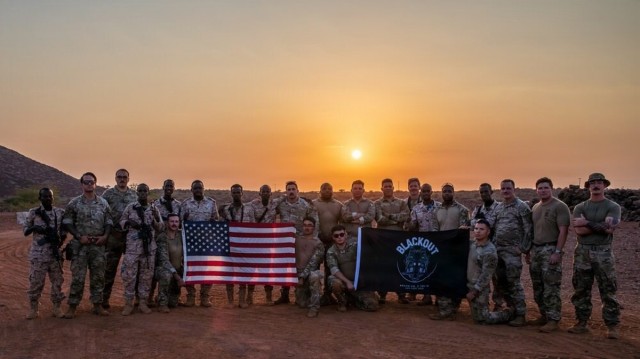
U.S. Soldiers from Logistics Company Advising Team 6640 and Djiboutian counterparts at Goubet Range. (Photo Credit: Sgt. Kyler Chatman)

A U.S. Soldier demonstrates night vision devices to Djiboutian soldiers. (Photo Credit: Spc. Shawn Warren)
Building Operational Independence
U.S. Army Chief Warrant Officer 3 Neil Limper emphasized the project’s objective of fostering self-sufficiency among Djiboutian forces. The initiative aligns with broad U.S. military goals to enhance the operational capabilities of allied nations. With this training, Djiboutian forces demonstrated they could independently train their remaining troops, marking a significant leap toward operational autonomy.
Importance of Interoperability
The joint exercises reflect a growing focus on interoperability between U.S. forces and those of Djibouti. Maj. Micah Bennett, a logistics advisor, pointed out that this partnership plays a critical role in the regional fight against extremism. With increased capabilities, the BIR can conduct operations in low visibility conditions, enhancing national security efforts in the Horn of Africa.
Continuous Support and Future Prospects
Ongoing collaboration between U.S. and Djiboutian forces signifies a commitment to stability in the region. The support from the East Africa Response Force and other U.S. military personnel underlines the integral nature of this mission. Looking ahead, U.S. forces will continue to engage in training exercises, reinforcing both forces’ readiness to tackle evolving security threats.
Navigating Challenges Together
Training in such environments brings its own challenges—from adjusting to local conditions to ensuring effective communication between forces. Yet, the persistent effort of American trainers and the dedication of Djiboutian soldiers ensures that both sides grow in competence and confidence.
About SETAF-AF
The U.S. Army Southern European Task Force, Africa (SETAF-AF), plays a vital role in shaping strategic military engagements across the continent. Its focus on crisis response, partner resilience, and readiness helps in addressing complex security dynamics. The initiative with Djibouti is just one example of its impactful work.
For ongoing updates, follow SETAF-AF on social media platforms such as Facebook, Twitter, and YouTube. Engage with the narrative of military collaboration that enhances both American and African military capacities.
