

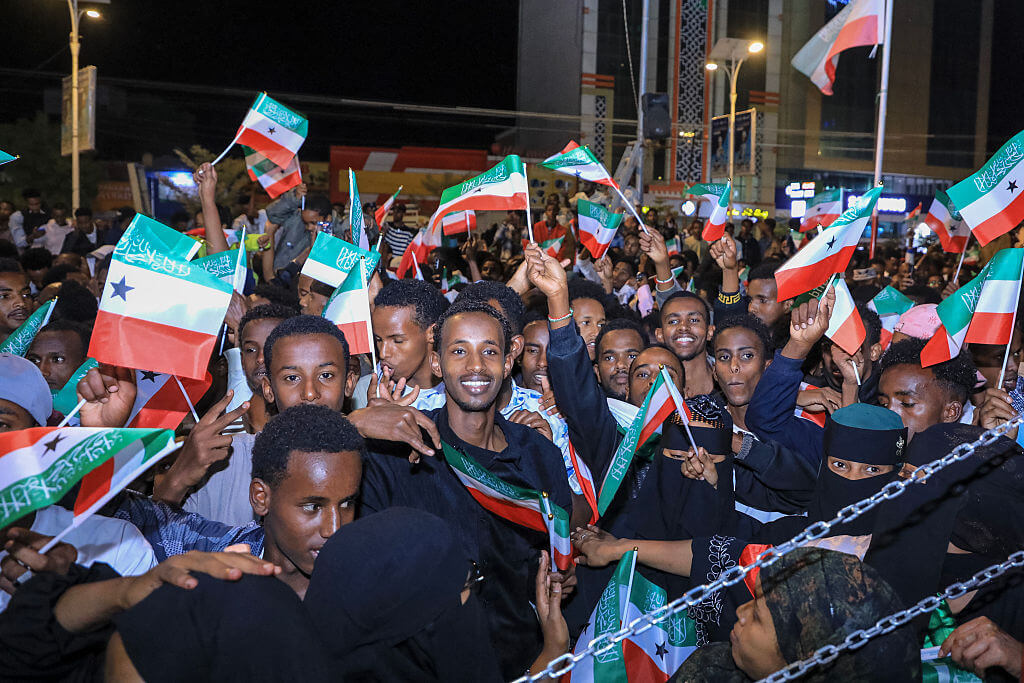
Residents wave Somaliland flags as they gather to celebrate Israel’s announcement recognizing Somaliland’s statehood in downtown Hargeisa. (Photo by Farhan Aleli / AFP via Getty Images) Photo by Farhan Aleli / AFP via Getty Images

By Hannah Feuer December 31, 2025
In a groundbreaking move, Israel has become the first nation to officially recognize Somaliland as an independent state. This landmark announcement has ignited a mix of celebrations and global outcry, serving as a catalyst for heated discussions on sovereignty and self-determination.
Located on the northern coast of the Horn of Africa, Somaliland has operated independently from Somalia since 1991. Following the collapse of Siad Barre’s regime, it declared its independence, though it had never secured formal recognition from any UN member states until now. With its own democratically elected government, military, currency, and even its own passports, Somaliland has established a framework for functioning as a state.
The region is often praised for its relative stability and success in conducting peaceful transfers of power. However, despite this progress, it remains categorized as “partly free” by Freedom House due to ongoing crackdowns on media and political dissent.
The smooth governance is often attributed to the dominant Isaaq clan, which has contributed to a more cohesive society amid the complexities of clan-based politics in the broader region. According to Seth Kaplan, a lecturer at Johns Hopkins, this social structure plays a crucial role in maintaining Somaliland’s relative peace and stability.
The Reaction from Somalia and Beyond
Somalia, however, considers Somaliland a part of its territorial integrity and has denounced Israel’s recognition as an “illegal act.” This assertion raises significant questions about the legitimacy of unilateral recognition in international law. While there are no laws that outright prohibit such actions, nations typically veer towards honoring established borders to avoid potential conflicts stemming from secessionist movements.
The African Union has been particularly vocal against this recognition, emphasizing that it poses a threat to regional unity and stability. Nuur Mohamud Sheekh, the spokesperson for the African Union, underscored that undermining Somalia’s territorial integrity runs counter to the core principles aimed at maintaining peace across the continent.
The historical context adds another layer to this ongoing dispute. Somalia’s borders were drawn during colonial rule, combining territories governed by different colonial powers. In 1960, British and Italian territories unified to form what we now know as the Somali Republic, laying the groundwork for ongoing border disputes.
Tens of thousands of Somalis protested against Israel’s recognition, brandishing Somali flags and voicing their dissent. Turkish President Recep Tayyip Erdoğan also condemned the move, calling it unacceptable and illegal.
Statehood and International Norms
Yet, the situation regarding Somaliland’s aspirations for recognition is not entirely clear-cut. International norms regarding the recognition of breakaway states are inconsistent. For example, Kosovo declared independence in 2008 and has been recognized by over 100 UN member states, despite Serbia’s claims over the region.
In this light, the U.S. Ambassador to the UN, Tammy Bruce, criticized the United Nations for what she perceives as a double standard in applying international norms. She noted that several countries have recognized Palestine as a state without sparking emergency meetings, contrasting sharply with the reaction to Israel’s recognition of Somaliland.
Somaliland’s case for independence is reinforced by its operational government and relatively stable society, fulfilling many criteria for statehood, such as a permanent population and defined territory. Kaplan pointed out that while he generally supports the principle against recognizing breakaway states, Somaliland stands out as a deserving case given its unique circumstances.
Israel’s Strategic Interests
For many observers, resistance to Somaliland’s independence seems less about genuine objections to its sovereignty and more about the broader geopolitical context, especially Israel’s strategic interests in the Horn of Africa. While the precise motives behind Israel’s recognition remain ambiguous, some analysts suggest it may serve as a foothold to exert influence in regional conflicts, particularly concerning Yemen and responses to Iranian activities in the Red Sea.
As part of the recognition process, Somaliland will now join the Abraham Accords, a series of normalization agreements between Israel and several Muslim-majority nations. This relationship could redefine dynamics in the region, further complicating the historical and ongoing tensions related to statehood and international recognition.
There’s also a sense of apprehension among Somaliland residents regarding the motivations behind Israel’s recognition. Some expressed disappointment that it was Israel, rather than a more universally accepted nation like Ethiopia or the UAE, that provided this long-awaited acknowledgment. Meanwhile, many celebrations have taken place, showcasing the mix of hope and uncertainty among Somalilanders at this pivotal moment in their history.
