

Algeria’s Upcoming Presidential Election: Continuity Amidst Uncertainty
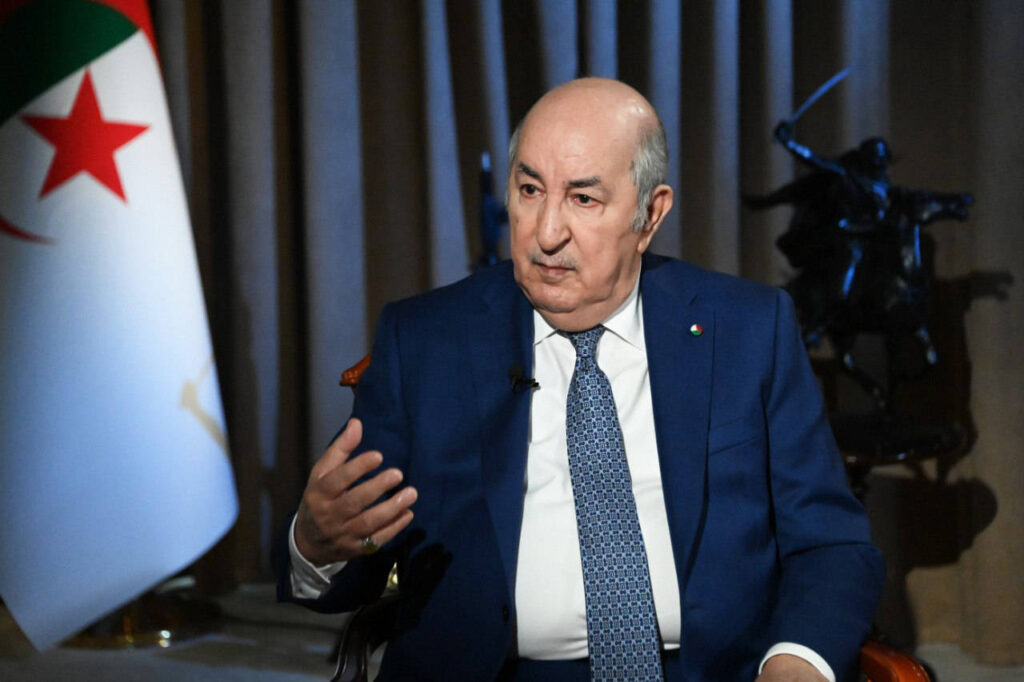
Algerian President Abdelmadjid Tebboune speaks during an interview with Qatar’s Al-Jazeera TV in Algiers on March 22, 2023.
Algeria’s forthcoming presidential election on September 7 promises to reaffirm President Abdelmadjid Tebboune’s hold on power. However, beneath this veil of assuredness lie profound questions regarding the nation’s political landscape and future.
The Stakes of Incumbency
Despite a track record that shows mixed results in foreign policy and economic management, Tebboune appears to have garnered increasing public support. Much of this support stems from his strategic reallocation of substantial oil and gas revenues, which have been funneled into expanded social programs. Furthermore, in Algeria’s political framework, which is heavily centralized, Tebboune benefits from the advantages that come with incumbency. His campaign is bolstered by the nation’s largest political organizations and social groups, many of which operate as extensions of the state, and crucially, by the backing of the military—a powerful entity that has manipulated the country’s political direction for decades.
The Uncertain Support of the Military
Interestingly, during the initial phase of his presidency, Tebboune’s rapport with the military was far less secure. After he took office in December 2019, the sudden death of army chief Ahmed Gaid Salah left a power vacuum that created uncertainty in the president’s support base. The ensuing period saw rumors of infighting and competition for influence between the presidency and the newfound military leadership. Such tensions even prompted independent journalists, like Ihsane El Kadi, to question the depth of military backing for Tebboune—a query that resulted in his incarceration, signaling a potentially chilling atmosphere for dissent.
A Climate of Intimidation
In the run-up to the election, the Algerian government has utilized various tactics to mitigate potential challenges to Tebboune’s leadership. Various political rivals have either been intimidated into exile or forced to withdraw from the political arena. The candidate registration process itself has seen allegations of electoral fraud, and in recent weeks, authorities have detained numerous political opponents—a move that coincides with an increase in state propaganda efforts.
These tactics reflect an underlying fear among Algeria’s ruling elite. Elections, rather than being seen as a democratic exercise, are fraught with a sense of vulnerability. Past electoral cycles—particularly the aborted elections of 1992 and the 2019 protests—underscore this sentiment, having shifted the political landscape dramatically.
Continuity Amidst Dissent
As the date approaches, the narrative surrounding Tebboune’s re-election remains focused on continuity rather than change. This is particularly evident in his return to populist policies designed to enhance his public mandate. While he may have strengthened military ties and tightened laws aimed at suppressing the Hirak movement, Tebboune also seeks to expand his connection with the electorate by appealing to citizen engagement during the campaign.
His previous electoral victory—garnering 58.1% of the vote—affords him a baseline, yet the lingering question is, how many Algerians will actually vote this time around? Historical data suggests that voter turnout has been on a consistent decline, culminating in a mere 39.9% participation in the last election. The situation raises pertinent questions about legitimacy and the nature of voter sentiment, especially amid widespread discontent with Algeria’s political process.
The Rationale Behind Participation Rates
To address participation, Tebboune’s strategy includes inviting controlled opposition, manifested through the candidacies of Youcef Aouchiche and Abdelaali Hassani Cherif. Both represent the “constructive opposition,” and their role appears to be more about building electoral credibility than posing a substantial threat to Tebboune’s presidency. Their presence is meant to serve as a signal of political legitimacy while simultaneously keeping genuine dissent at bay.
Despite these efforts to foster voter engagement, many distrust the electoral process, viewing it as a façade for an entrenched regime. If turnout fails to surpass 2019 figures, the government may deflect criticisms by blaming external factors like timing and the holiday season.
Implications for the Future
Ultimately, Algeria’s presidential election is more than a simple vote; it is a barometer of the country’s political health. If voter engagement can increase, the administration may emerge with a renewed mandate. However, a low turnout would reinforce the prevailing sense of disenfranchisement among the populace. The outcome will determine not only Tebboune’s political future but also the fate of reforms and potential shifts towards more participatory governance in Algeria.
For many citizens yearning for meaningful change, the wait continues.
